
Estimated reading time: 9 minutes
A straight smile is not just about appearance — it also contributes to better oral health, easier cleaning, and improved confidence. Clear aligners have become a popular alternative for teenagers and adults who want a more discreet path to straighter teeth. One of the most common questions patients ask at Sri Tatva Dental Care is: "How do aligners actually work?" This guide answers exactly that.
Clear aligners apply gentle, controlled pressure to specific teeth through a series of custom-made transparent trays. Each tray moves your teeth a small amount. Over weeks and months, the cumulative movement achieves your planned smile. No brackets. No wires. Nearly invisible.
What Are Clear Aligners?
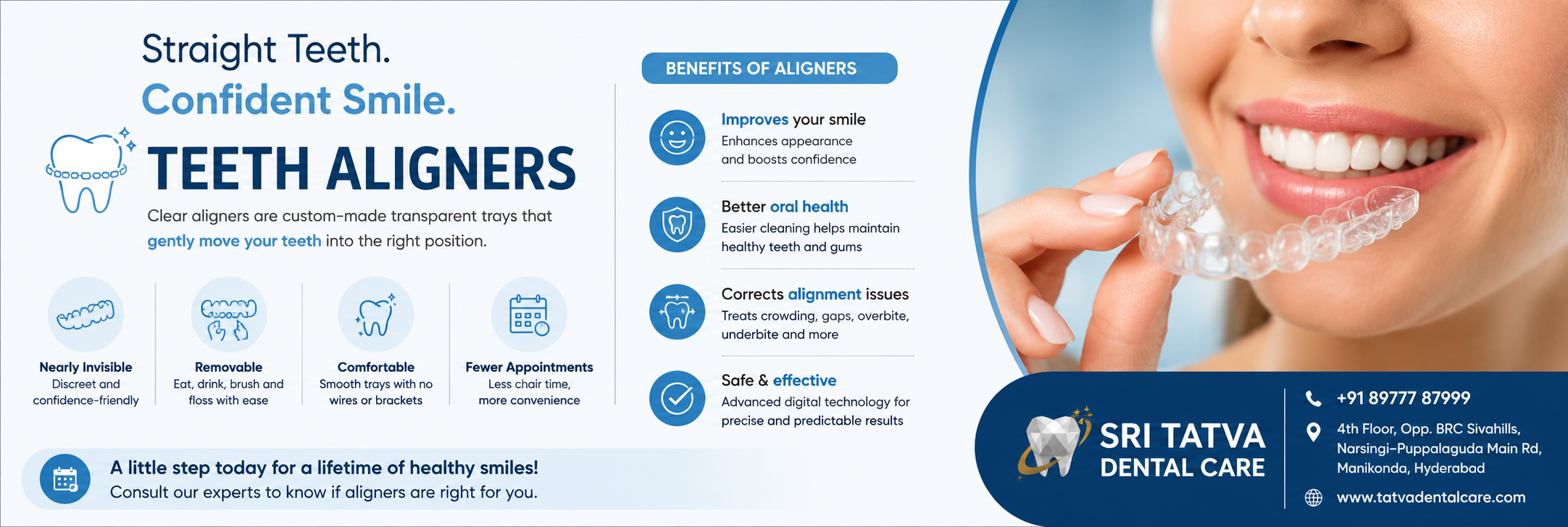
Clear aligners are custom-made, transparent trays designed to gradually move teeth into their ideal position. Unlike traditional metal braces, aligners are removable and almost invisible when worn.
Each aligner is created using advanced digital scanning technology and is precisely designed for your teeth alone. As you progress through a series of aligners — typically changing to a new set every one to two weeks — your teeth move little by little until the desired alignment is achieved.
The Science Behind How Teeth Move
Many patients find it difficult to believe that a thin transparent tray can actually move teeth. But the process is grounded in well-established orthodontic biology.
Your teeth are not permanently fused to the jawbone. They are held in place by the periodontal ligament — a fibrous tissue that allows controlled movement when steady pressure is applied. When an aligner exerts pressure on a tooth, the following happens inside your jaw:
Bone Remodelling — Step by Step
- 1Pressure applied: The aligner pushes a specific tooth in the planned direction.
- 2Bone resorption: Bone cells (osteoclasts) break down bone on the pressure side — the direction the tooth is moving toward.
- 3Bone formation: New bone cells (osteoblasts) deposit new bone on the opposite side, stabilising the tooth in its new position.
- 4Tooth repositioned: The tooth has moved safely and incrementally. The next aligner repeats this process for the next planned movement.
This process happens slowly and safely under professional supervision. It is the same biology that braces use — aligners simply deliver the pressure differently.
Step-by-Step: The Aligner Treatment Process
Here is exactly what happens from your first appointment at Sri Tatva Dental Care to your final smile.
How Many Hours Must You Wear Aligners?
This is the most critical factor in treatment success. Aligners only work when they are in your mouth.
The only times you remove your aligners:
Every hour your aligners are out of your mouth, your teeth begin reverting slightly. Patients who consistently remove aligners for extra hours often find their treatment takes significantly longer than planned — or requires extra aligner stages.
What Dental Problems Can Aligners Correct?
Clear aligners can address a wide range of orthodontic concerns. Here is what they can treat:
Benefits of Clear Aligners
Are Aligners Suitable for Everyone?
Aligners are highly effective — but not every case is suitable. Here is a clear breakdown of who qualifies and who may need a different approach:
✓ Good Candidates
- Teenagers with fully erupted permanent teeth
- Adults seeking discreet orthodontic treatment
- Mild to moderate crowding or spacing
- Minor bite corrections
- Patients with good oral hygiene habits
- Those who can commit to 20–22 hrs/day wear
→ May Need Alternatives
- Severe crowding or complex bite issues
- Significant skeletal jaw discrepancies
- Children with mixed dentition (milk + adult teeth)
- Patients with active gum disease or bone loss
- Cases requiring significant tooth rotations
- Those who cannot commit to consistent wear
Online assessments and photos are not sufficient to determine whether aligners are right for you. A digital scan and professional consultation at Sri Tatva Dental Care will give you a definitive answer — and if aligners are not the best fit, we will explain exactly why and what alternative would work better.
How Long Does Aligner Treatment Take?
Treatment duration is directly tied to the complexity of your case and your consistency in wearing the aligners as prescribed. Here are general timeframes:
months
months
months
These are estimates. Your dentist will give a personalised timeline at consultation based on your specific 3D scan and treatment plan.
How to Care for Your Aligners
Proper care keeps your aligners clean, clear, and effective throughout treatment.
✓ Do This
- Rinse aligners with lukewarm water every time you remove them
- Clean gently with a soft toothbrush (no toothpaste — it scratches)
- Store in the protective case when removed
- Brush your teeth before reinserting aligners
- Keep to the 20–22 hour daily wear schedule
✗ Avoid This
- Hot water — it warps the plastic permanently
- Leaving aligners exposed on a surface (bacteria + damage risk)
- Eating or drinking (except water) with aligners in
- Using coloured or flavoured mouthwash to soak them
- Skipping aligner changes thinking it makes no difference
Frequently Asked Questions
Ready to Transform Your Smile?
Clear aligners offer a comfortable, discreet, and effective way to straighten teeth without the appearance of traditional braces. At Sri Tatva Dental Care, Hyderabad, we assess your smile using advanced digital scanning and create a fully customised aligner plan — with a preview of your result before you begin.
📞 Call +91 89777 87999 Book Consultation OnlineThis article is authored and reviewed by the clinical dental team at Sri Tatva Dental Care, Hyderabad. Our dentists bring experience across general dentistry, orthodontics, and digital smile planning. All content is intended for patient education and awareness, not as a substitute for professional diagnosis and treatment.