Estimated reading time: 8 minutes
That throbbing, stabbing, sometimes unbearable pain in your tooth is your body sending an urgent signal. It is not just discomfort — it is your tooth trying to tell you that something is seriously wrong inside. Understanding what is actually happening can be the difference between a simple filling and losing the tooth entirely.
If you have severe throbbing tooth pain right now — especially with swelling, fever, or difficulty swallowing — scroll to the emergency section or call us immediately. This could be a dental abscess, which is a medical emergency.
First — Let's Understand What's Inside Your Tooth
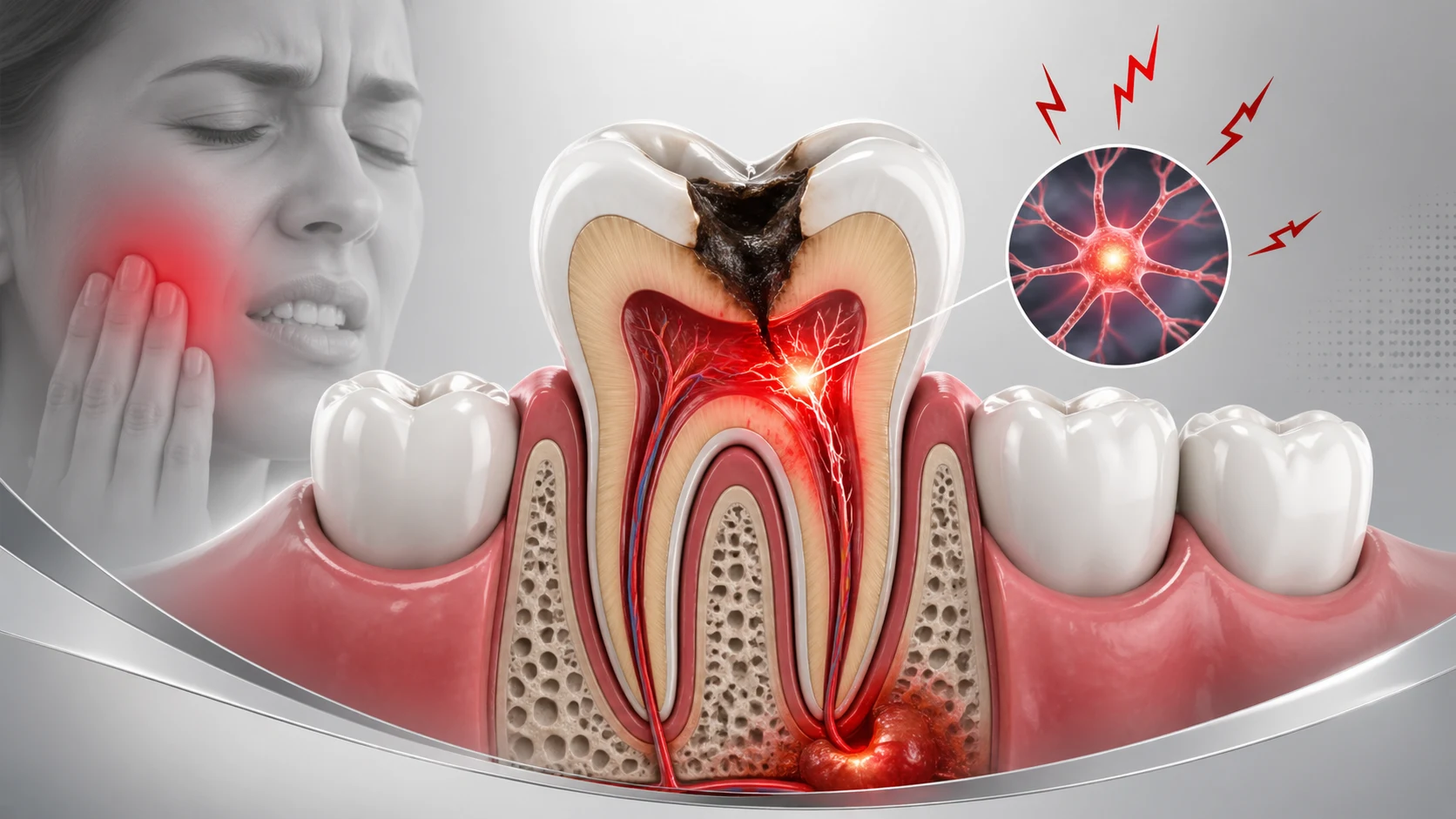
Your tooth is not solid. It has layers, and each layer plays a specific role. When pain strikes, identifying which layer is affected tells us exactly what is going wrong inside.
The Anatomy of Your Tooth
- 1Enamel — The Outer Shield The hardest substance in your body. When intact, it protects everything inside. There are no nerves here, so damage to enamel alone causes no pain — but it is the first line of defence to fall.
- 2Dentine — The Pain Messenger The layer beneath the enamel. It contains thousands of microscopic tubules that carry signals to the nerve. When dentine is exposed by a cavity, crack, or gum recession, you feel sensitivity and sharp pain. This is where most tooth pain begins.
- 3Pulp — The Living Core The innermost chamber containing blood vessels and the nerve. When bacteria reach the pulp, it becomes inflamed or infected — this causes the agonising, throbbing, constant pain. A root canal becomes necessary at this stage.
- 4Root and Surrounding Bone The foundation of the tooth. When infection travels beyond the pulp to the root tip and surrounding bone, it forms an abscess — a pocket of pus that can spread and become serious if left untreated.
How Pain Progresses: Stage by Stage
Tooth pain follows a predictable escalation. The earlier you act, the simpler and cheaper the treatment. Here is what each stage looks and feels like:
Why Is Your Tooth Hurting? The Most Common Causes
Tooth pain has many possible sources, and each presents differently. The table below summarises the most common causes we see at our clinic and how urgent each one is.
| Cause | How It Feels | Urgency |
|---|---|---|
| Dental Cavity (Caries) | Sensitivity to sweets and cold, dull ache when biting | Moderate |
| Pulpitis (Nerve Inflammation) | Throbbing, spontaneous pain, worse lying down | Urgent |
| Cracked Tooth Syndrome | Sharp pain when biting, then releases; inconsistent | Moderate |
| Dental Abscess | Constant severe pain, swelling, fever, bad taste | Emergency |
| Gum Disease (Periodontitis) | Aching, pressure, teeth feel loose | Moderate |
| Impacted Wisdom Tooth | Deep ache in back jaw, pain radiating to ear | Moderate–High |
| Exposed Root (Gum Recession) | Sharp response to cold and touch near gumline | Low–Moderate |
| Bruxism (Teeth Grinding) | Generalised aching, jaw soreness, morning headache | Low |
Why Does Tooth Pain Get Worse at Night?
This is one of the most common questions we hear at our clinic. You manage through the day, but the moment you lie down, the pain becomes unbearable. Here is the science behind it.
When you lie flat, blood pressure in your head increases slightly. This causes greater blood flow to the already inflamed pulp, which amplifies the throbbing sensation. During the day, an upright posture and constant distractions reduce this effect. At night, your brain has nothing else to focus on — the pain is all there is.
Pain that reliably worsens when you lie down is almost always a sign of pulpitis — the pulp inside your tooth is inflamed or infected. This stage requires a root canal or extraction. It will not resolve on its own. Every day of delay allows the infection to deepen.
My Tooth Stopped Hurting — Does That Mean It's Better?
This is one of the most dangerous misconceptions in dental health. A toothache that suddenly stops is often not a good sign. In many cases, it means the nerve inside the tooth has died from the infection. The tooth has gone numb — not healed.
The infection does not disappear. It quietly spreads from the dead tooth to the surrounding jawbone, often forming an abscess. By the time the pain returns — usually more severe — significant damage has already occurred. If your tooth pain has recently stopped on its own without treatment, please visit us anyway for a check-up.
- Pain that is severe and does not reduce with painkillers
- Swelling in your face, cheek, or jaw
- Fever above 38°C along with tooth pain
- A visible bump or pimple on your gum (fistula)
- Bad taste or pus discharge near the tooth
- Difficulty swallowing or breathing — call emergency services immediately
What Will the Dentist Actually Do?
When you come to Sri Tatva Dental Care with tooth pain, here is what to expect — no surprises, no pressure, just clear next steps.
1. Diagnosis First
We take a digital X-ray and perform a clinical examination to identify exactly which tooth is affected, which layer is involved, and whether there is an abscess. We also listen to your pain description carefully — the character of pain (throbbing versus sharp, constant versus triggered) tells us a great deal about the underlying cause.
2. Treatment Based on Stage
Early cavity: A tooth-coloured composite filling — quick, painless, and the tooth is saved completely.
Deep cavity near pulp: A medicated liner is sometimes placed first to calm the nerve before a final filling is done.
Pulpitis or infected pulp: Root canal treatment — the nerve is removed, canals cleaned and sealed. The tooth is saved and you feel no pain during the procedure.
Abscess: Drainage of the abscess and antibiotics, followed by root canal or extraction depending on severity.
Cracked tooth: Depending on the depth of the crack, treatment may be a filling, a crown, or extraction.
3. Pain Relief
You will leave with significantly reduced pain after treatment. If needed, we prescribe appropriate pain relief and antibiotics. Root canal treatment, despite its reputation, is not painful — it actually relieves the pain you came in with.
Frequently Asked Questions
Tooth Pain Needs to Be Seen Today
Don't suffer through the night hoping it gets better. At Sri Tatva Dental Care in Hyderabad, we diagnose tooth pain accurately and provide immediate relief. Same-day appointments available for emergency cases.
📞 Call for Appointment Book OnlineThis article is authored and reviewed by the clinical dental team at Sri Tatva Dental Care, Hyderabad. Our dentists bring experience across general dentistry, endodontics, and oral surgery. All content is intended for patient education and awareness, not as a substitute for professional diagnosis and treatment.
